
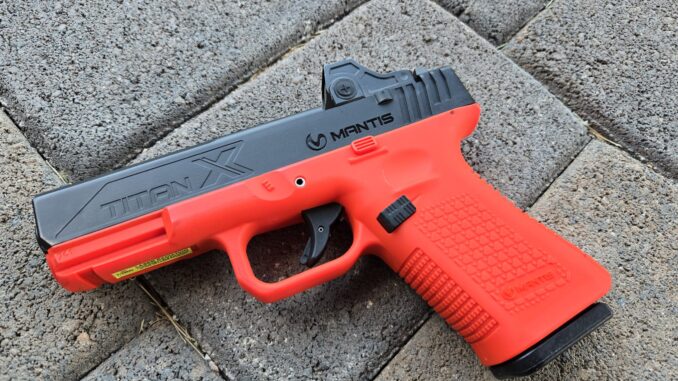
During this year’s SHOT Show I had the opportunity to get hands-on with the new Mantis TitanX. Fast forward to this Summer and Mantis reached out to see if I’d be interested in getting more time on the TitanX for a review. Curious to see how it compared to my original Mantis and some other dry fire tools, I gave them the thumbs-up. A couple weeks later and I had one in hand. Now that I’ve had a few months of time, here is my review of the Mantis TitanX.
Design of the Mantis TitanX
The TitanX is the latest dry practice tool from Mantis. Rather than a rail-mounted device, this is an all-in-one Glock replica. It features all-plastic construction, a non-reciprocating slide, and a bright red frame similar to other dummy guns. Grip texture is unique to the TitanX, slightly smoother than a factory Glock. I could see this texture being overly slick on a real pistol, but is a non-issue for my dry practice. The traditional Mantis system comes built into the TitanX, charged via a USB-C port on the barrel hood. If you’re familiar with Mantis, and familiar with semiautomatic pistols, this should be familiar to you.
This particular model is modeled after the G17. Users also have the choice of G19 and G45 models as of this writing. Per Mantis, there are HK, Walther, SIG variants in development as well.
The Trigger
As a disclaimer, the Mantis TitanX is not a real Glock. As such, the trigger press is not a perfect replication of a real, OEM, Glock trigger in terms of feel or the break. I went into this review expecting some differences, and was generally pleased with what I found. The TitanX provides an actual trigger break, unlike some dry fire products. The press is lighter, with a less dramatic break than a real Glock, but it’s not a total sponge either. In my experience, the trigger break is enough to disturb your sights, and is noticeable for the shooter’s trigger finger. It’s somewhat similar to aftermarket triggers I’ve felt, though which specific models escape my memory as of this writing.
The trigger shoe itself is effectively a perfect replica to my mind and finger. In terms of “muscle memory”, grasping the gun and pressing the trigger on the TitanX is very similar to my real guns. There is no artificial hesistation, or confusion during my dry practice, which is a good thing.
The Sights on the Mantis TitanX
The sights on the Mantis TitanX are a close replication of stock Glock sights. While this may be an issue for some, I found this to be just fine in my practice. Logistically, I think this makes a lot of sense. Glock sights are Glock sights, and the vast majority of shooters keep the factory irons on their guns. I don’t think it’s reasonable to expect Mantis to choose an aftermarket option for their gun. Would I like to have user-changeable sights on the TitanX? Sure. However the effort to dovetail a rear sight would increase costs significantly. Additionally, there isn’t a way to swap the front sight, so it’s a bit of a moot point unless Mantis went with another style of sights, which would invite its own new criticisms.
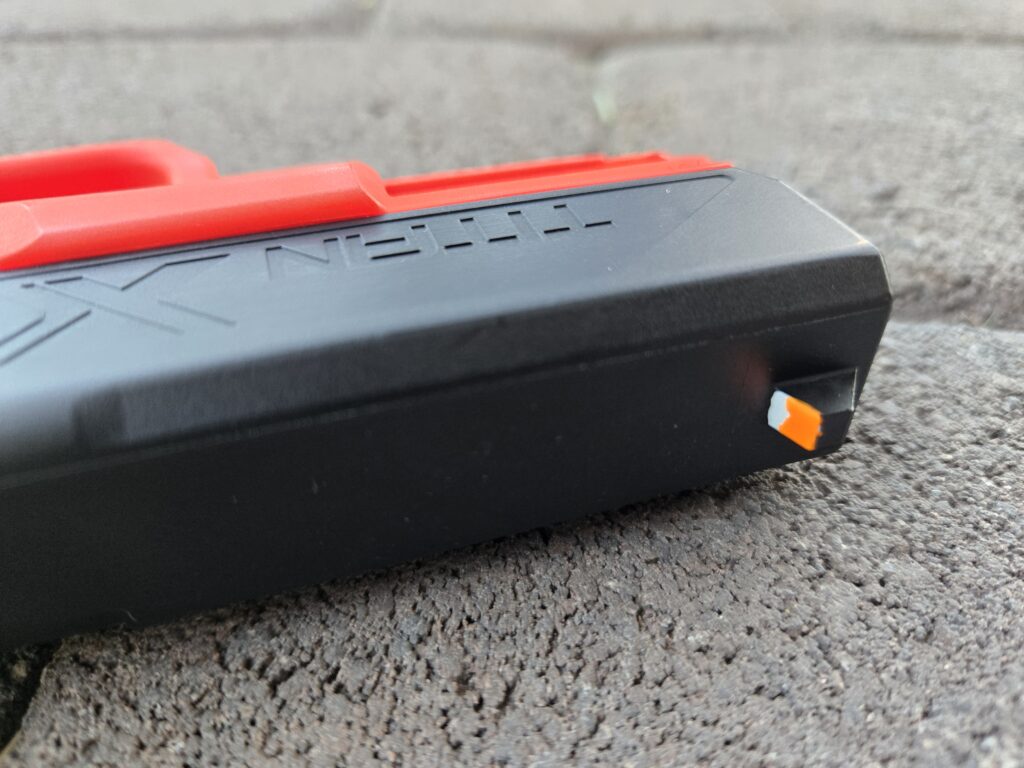
I made two changes to the sights on my TitanX during the review process. The first was painting my front sight in a similar fashion to the rest of my guns. This improves visibility in general, and better aligns my practice with what I’d see with my real guns. The second change was taking a Sharpie to a glossy section of the rear notch to reduce glare in direct light. This glossy section is where the white “basket” outline of the OEM Glock rear sight normally sits. These two changes brought the TitanX closer to what I typically see with my irons-equipped Glocks. And that’s a good thing.
In short, these are useful sights. They are aligned properly. They are reasonably finished, with no misshaping, burrs, or abnormalities. That’s more than I can say about some other dry practice tools. I spent the first two months of my time exclusively using iron sights on my TitanX.
The Magazine
The Mantis TitanX features a detachable magazine, coming with two mags in the case. These insert and release just like a standard magazine, allowing users to practice their speed reloads. Remember, the slide on the TitanX is non-reciprocating, so no slide-lock reloads will take place here. The included magazines are weighted, to help give the pistol some realistic heft, and allowing ejected magazines to drop free.
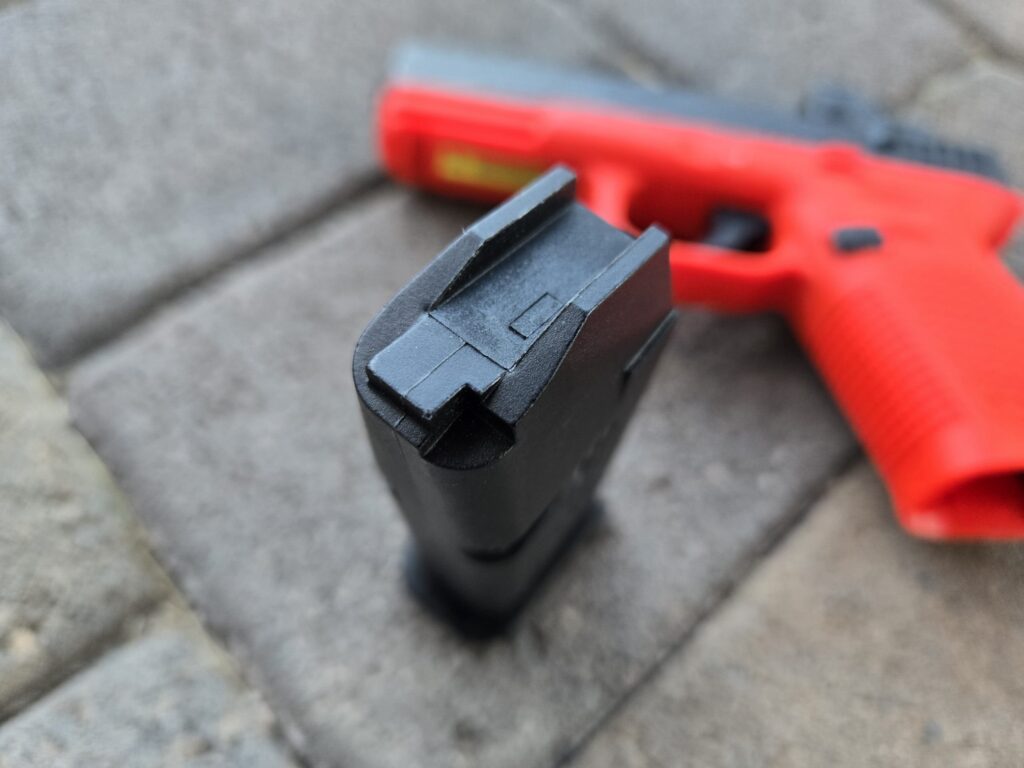
The magazine is shaped like a totally empty magazine, with no round on the follower. That means we have two feed lips with a recessed portion between, just like an empty magazine. This is one of my complaints regarding the TitanX. The magazine should be shaped as though there is a cartridge sitting on the follower. In its current design, this gap can hang-up if you are sloppy with your reloads. That can cause problems when pushing speed or for those less experienced. While I can make this work just fine, it’d be better if the magazine was set up as if it was loaded. Outside of that, the quality seems to be solid. While I haven’t dumped these dummy magazines on the floor, they have stood up well to full-speed reloads without issue.
Holster Compatibility of the Mantis TitanX
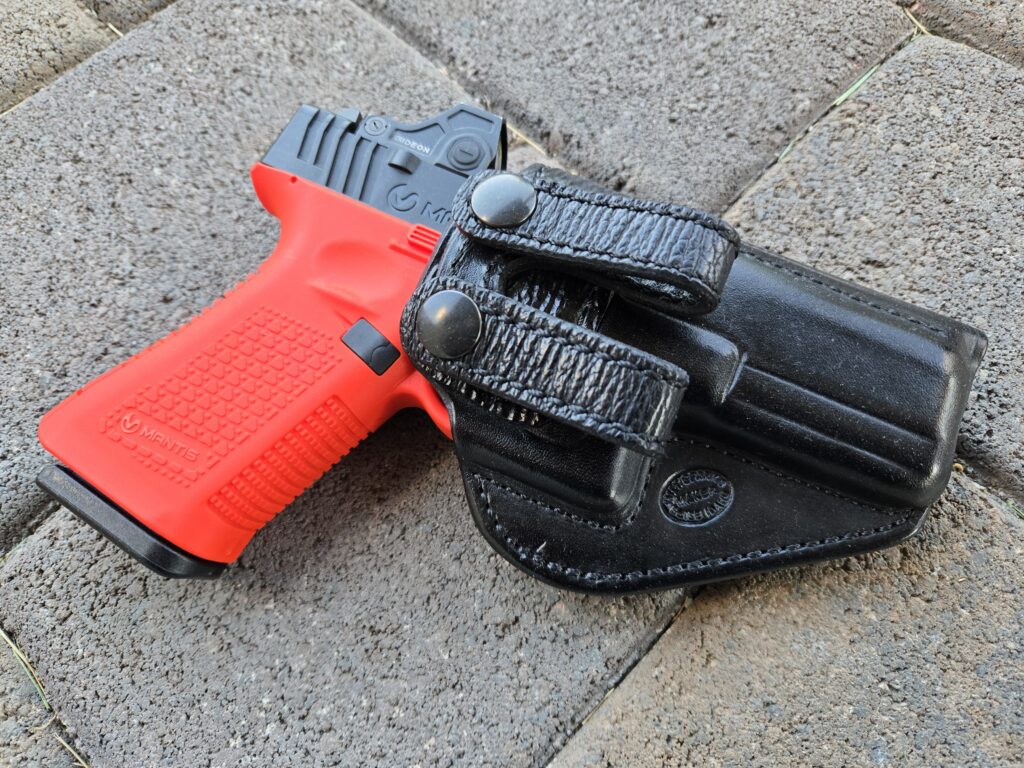
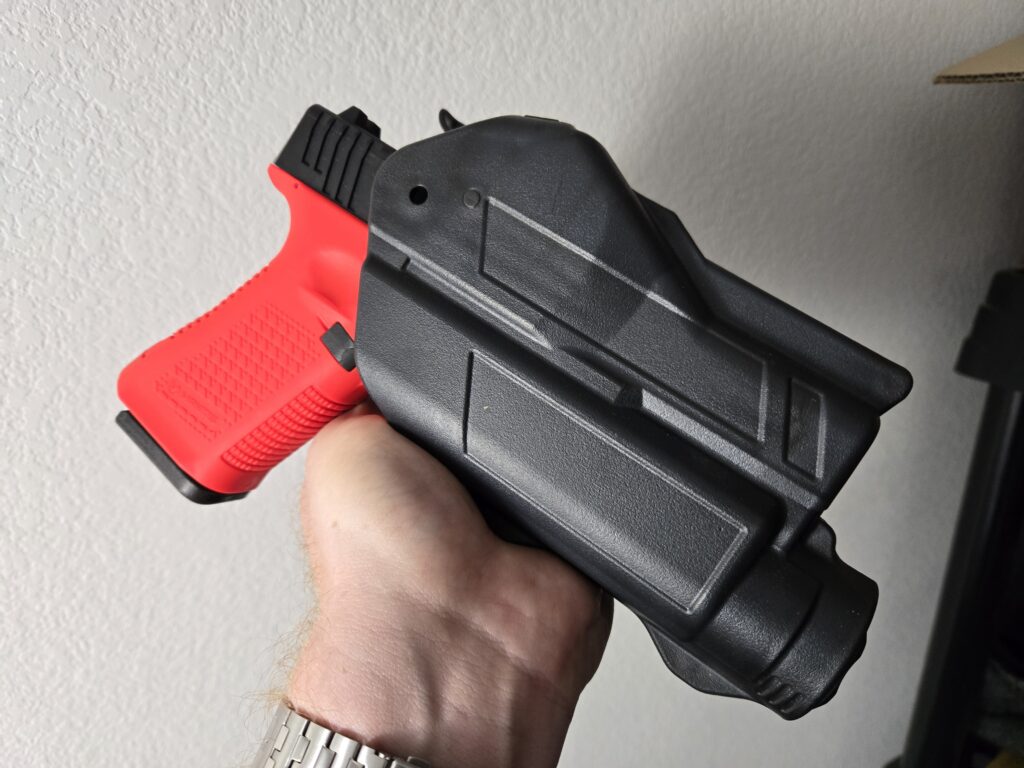
I paired several holsters with the Mantis TitanX throughout the review process. While I assumed it would work well with a variety of Glock holsters, I wanted to do my due diligence considering the TitanX isn’t a real firearm. Below is the list of holsters I used during my review process.
Bravo Concealment Torsion
Galco Summer Comfort
JM Custom Kydex IWB3
KSG Armory Halcyon
KSG Armory Lexington
Milt Sparks Summer Special
Milt Sparks Summer Special 2/SS2
PHLster Pro
Tenicor Velo4
Safariland 6354DO with X300U
Safariland 6360RDS with X300U
Alien Gear Rapid Force with X300U
Blackhawk T-Series L2D with X300U
As you can see, the Titan seems to work well with a diverse selection of holsters. From strong side to AIWB, leather to kydex, I had no issues with retention or access regardless of the holster of the day.
As an Aside
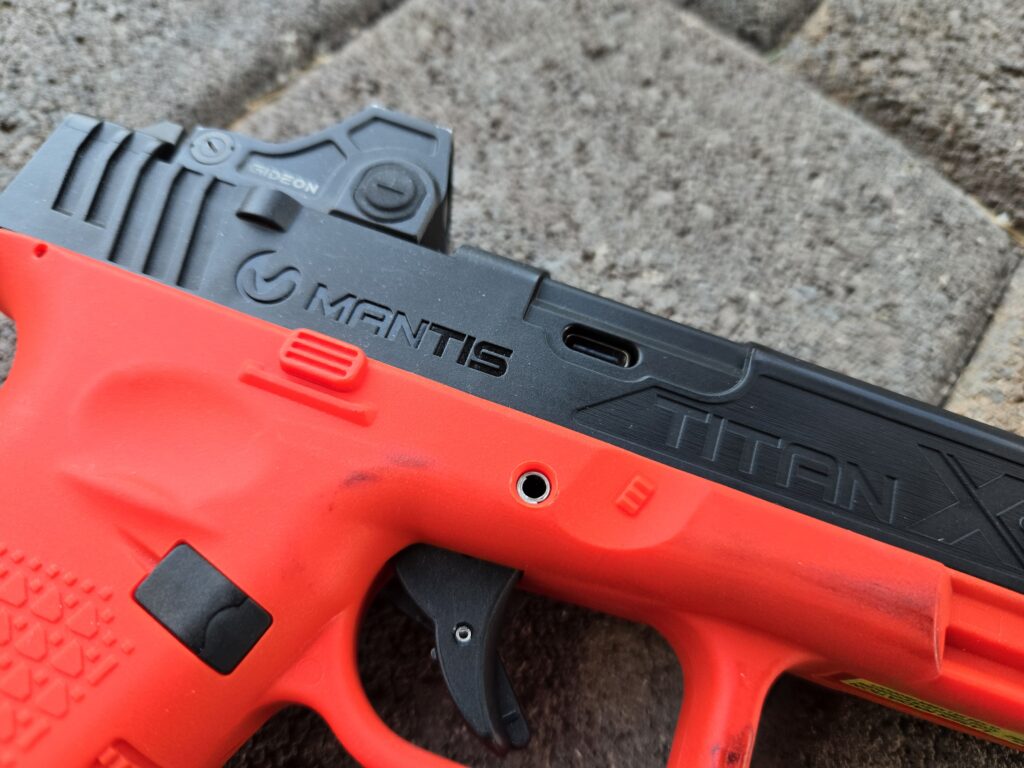
There is one asterisk for holster compatibility here. As mentioned above, the USB-C charging port is located on the barrel hood. Due to this, there is less room inside the ejection port, with the barrel hood of the Mantis TitanX sitting a little more proud within the recess than on a real Glock. With this in mind, you may have reduced retention when using a non-light bearing Safariland ALS holster, which retain the gun off of the ejection port. I was not able to source a holster to validate this for the review, so I cannot speak authoritatively to this subject. However I believe it is worth mentioning.
Optic Compatibility
The Mantis TitanX is optic ready from the factory. It ships with a polymer plate covering the optic pocket, giving a clean appearance to the slide. Removing this plate reveals two footprints cut directly into the slide of the TitanX. These are the Trijicon RMR and Shield Sights RMSc footprint. No conversion plates necessary, so long as you stick with these footprints. The pocket has quite a bit of extra room built in, which should allow for most optics to fit on the TitanX. While a little unsightly, the extra space is no issue since there is no recoil to worry about.
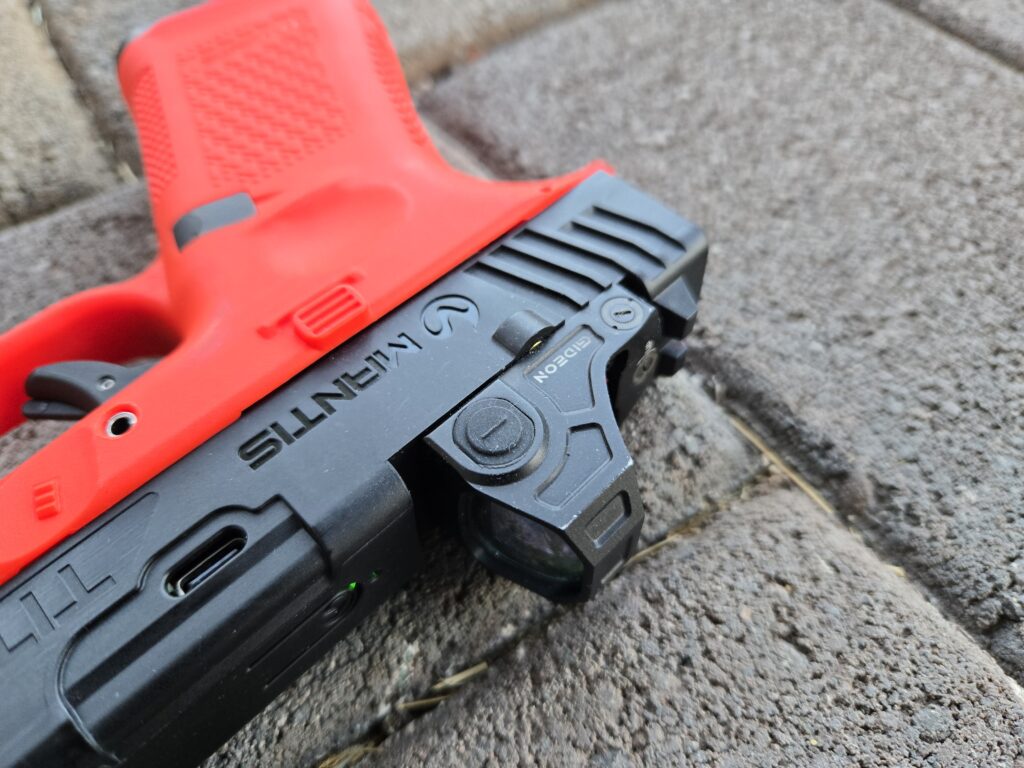
Mantis does not include screws for mounting your optic, meaning you’ll have to supply your own. Initially I wasn’t excited about this prospect, but over time my opinion changed. With the massive variety of optics out there today, and supporting two different footprints, I think it’s reasonable to have users supply their own screws. The TitanX uses M3 X 0.5 screws to mount optics, which is molded into the optic cut, a nice and informative touch. While the slide is fully plastic, there are metal inserts for the screws to attach to, reducing wear if swapping optics regularly.
I mounted a Gideon Optics Judge on my TitanX, which fit well with the Gideon’s included screws. To zero my optic I started by slaving the dot to the irons at point blank. From here I gradually adjusted the reticle based upon hits with the laser at 10 yards until I reached a sufficient zero. It’s a little more tedious than with live fire since you don’t have bullet holes to help keep things on track, but the whole process only took a few minutes.
The Laser on the Mantis TitanX
For several years I was critical of laser-based dry practice tools. In my mind, these encouraged shooters to dip the gun or raise their head in an effort to find the laser. That shooters shouldn’t be seeing the laser at all, so who cares? After several months with the Mantis TitanX, my thoughts have changed.
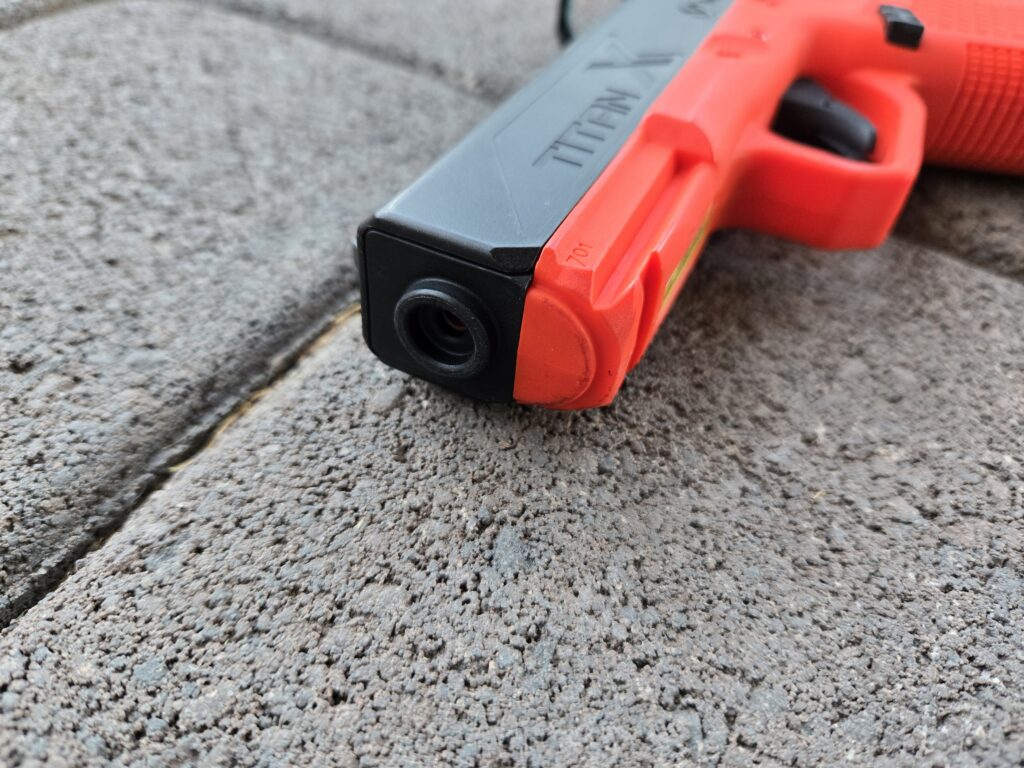
Although I am not focused on the laser, I can often see where it “hits” when pressing the trigger. With a properly zeroed Titan, this allows me to be more accountable with my shots, showing where my grip fails or trigger presses go awry. A good trigger press means that I probably will not see the laser. A poor trigger press or flinch will often result in the laser briefly appearing, letting me know that I made an error with more precision than what my sights are capable of showing. That is magnified when “shooting” at more distant targets, giving greater deviation between Point of Aim and Point of Impact. This level of feedback is technically possible with regular dry practice, but the level of skill and focus required to call shots may not be available for certain users.
The ability to see the laser has also been beneficial as an instructor. I no longer have to solely rely on subtle movements of the gun, or the student analyzing the feedback given to them by the gun. With the laser I can now combine those two aspects with the impact of the laser itself, giving me a tertiary method of diagnosing marksmanship issues.
Zeroing the Laser
The Mantis TitanX arrived from the factory with the laser zeroed to the irons. I’m able to keep my “shots” within a 4-inch circle at 10 yards, or a 1-inch circle at three yards. This is sufficient for my purposes, and I did not use the TitanX at further distances. Despite this, I did briefly adjust the zero for purposes of the review. Adjustments are made using a small wrench, with the elevation and windage being found near the muzzle end of the slide.
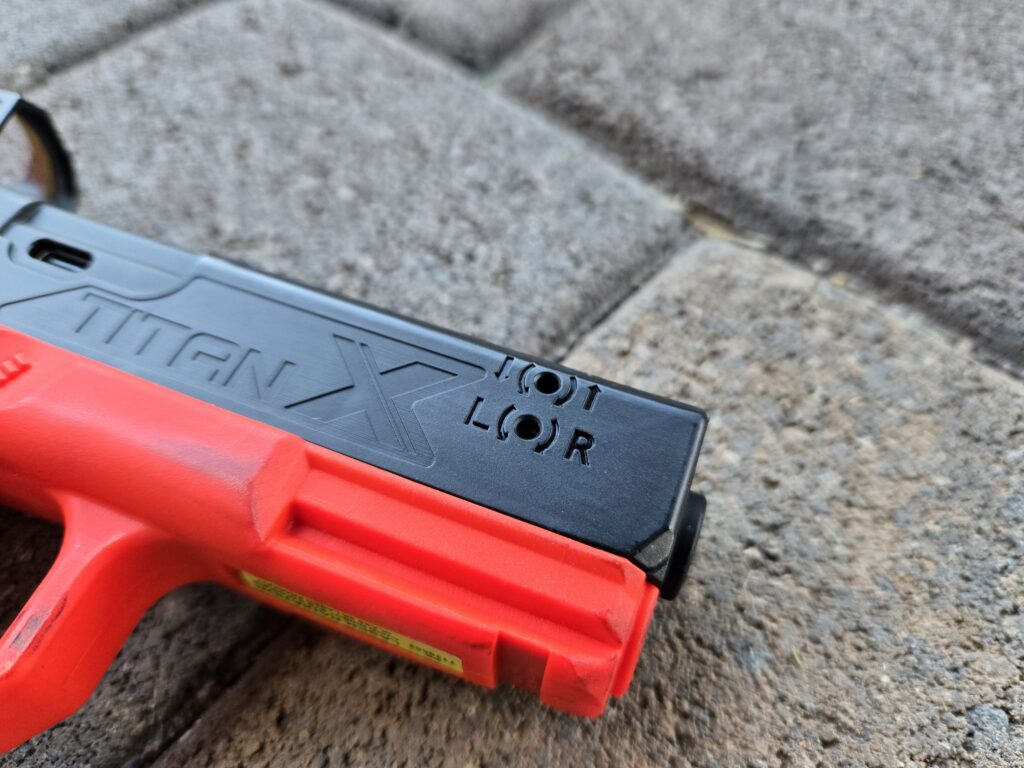
There are no tactile or audible clicks when zeroing the laser, just a smooth rotation. I’d prefer there to be defined “clicks” to help with adjustment, but this isn’t a deal killer for me. I recommend making physical references when adjusting, such as quarter turns.
TitanX Laser Use in Daylight
While the vast majority of my time using the Titan occurred indoors, I did take it outside to see how it fared in the great outdoors.
In direct midday sunlight the laser is only visible to about six feet or so. While this isn’t great, it’s actually better than what I expected. In shade the laser was clearly visible out to 10 yards, which was the maximum distance tested. I don’t consider the TitanX to be a tool to be primarily used outside, so this performance is more than adequate for me.
Inside the Mantis App
This isn’t my first time using a Mantis system. Back in 2019 I was given an original MantisX by Patrick Roberts, which saw quite a bit of use during 2020’s lockdowns. There have been quite a few changes over the past seven years.
The app has a wide variety of timed drills and untimed exercises. I typically focus on the timed and untimed Benchmark for freestyle shooting, along with strong and weak hand only exercises. One of the big changes that I really like are the the decision making drills–a stand out feature for me. This offers some great dynamic practice, changing things up from simple shooting technique. In addition to these exercises, there are several guided courses to provide regular challenges and progression. Some of these courses require regular use for progression, which can help procrastinators like me stay on top of their practice routine.
The Mantis app is not TitanX specific. There are some drills which are meant to be done using a standard Mantis system and a real pistol. Additionally there are some analysis features which are not compatible with TitanX, such as various recoil analysis options. Not a knock on TitanX, just something to be aware of to avoid confusion. On a final note, Mantis added some new drills and features during the review process, which helps keep things interesting for those heavily using their app.
Different Strokes for Different Folks
Despite some changes over the past few years, I largely feel the same about the MantisX system. New shooters will likely see the most benefit, with a higher likelihood of seeing new concepts and techniques.
For more experienced shooters, Mantis turns dry practice into a bit of a game. With statistics, pleasing visuals, the option to join groups or follow friends, the app is a good motivator. That’s what got my attention with the original MantisX, and it’s even more attention-grabbing now. Any extra reason to pick up our tools and practice is benefit, so kudos to the TitanX for that.
Administrative Use
It is very easy to swap between users on different devices for a shared Titan within the home. While my wife doesn’t use the TitanX often, the ease of swapping between users is nice when she does pick up the gun. Swapping users isn’t actually an accurate term. If each person using the TitanX has the Mantis app installed on their phone, simply press the sync button on the gun and your app, wait a few seconds, and you’re good to go. A shared device is also an option, with a “guest” setting available within the Mantis app.
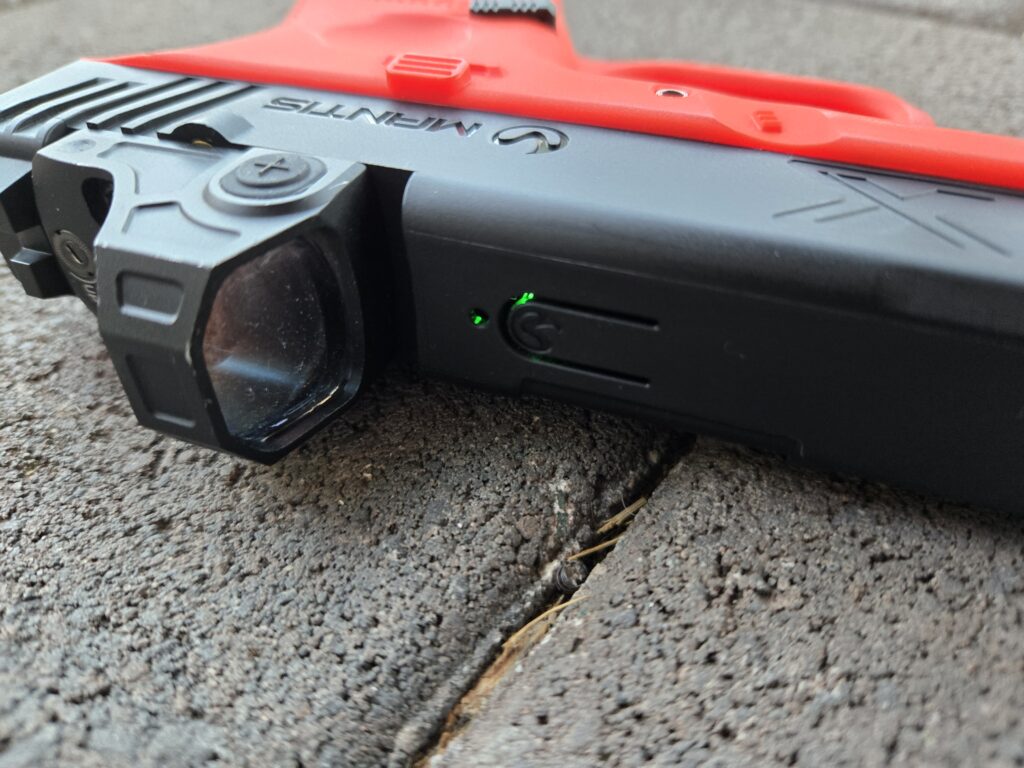
Battery percentage on settings tab is a nice feature, and the battery life itself is also very good. I fully charged the TitanX upon receipt. Over 1,000 trigger presses and a few months later, the gun has yet to issue me any warnings for low battery. I expected the TitanX to need to be charged after every few sessions, so this is pleasantly surprising.
Mantis TitanX Uses Outside of Traditional Dry Practice
The Mantis TitanX is a solid dry practice tool. However I think it’s more than just a way to pull a trigger without something going “bang”. A large portion of my use has been using the TitanX in situations where live firearms are inappropriate or unacceptable but more realism than a typical dummy gun is desired. It’s been a fantastic teaching tool, both for myself and students.
It’s great peace of mind to have something completely incapable of firing live ammunition when conducting training that may result in a muzzle passing over something you don’t wish to kill or destroy. Maybe we’re teaching fundamentals of marksmanship in a classroom that doesn’t have a truly safe direction to point the muzzle. It may be time to start teaching our children or partners how to safely handle guns. Perhaps we’re working close quarters shooting, or experimenting with our concealed carry and babywearing setup.

Whatever the reason, the TitanX has been a great addition to our training plan. It’s allowed and encouraged us to practice and train with much more regularity than before. The ability to see useable sights, press a trigger, and the video game-like incentive of the Mantis system are great motivators. The included laser is another great benefit, letting us validate muzzle position safely, seeing where our “hits” end up when breaking down processes and debriefing our sessions.
Comparison to Other Dry Practice Tools
This isn’t to say that the Mantis TitanX is the only option for a dummy gun. However, I think it offers a lot of bang for the buck. There are a variety of other dummy pistols out there that give you magazine swaps, trigger presses, lasers and more. In terms of realism, it’s about a wash between most of them, with not-quite-right triggers, inaccurate weights, and fixed sights. Many don’t offer the option to easily mount optics from the factor either.
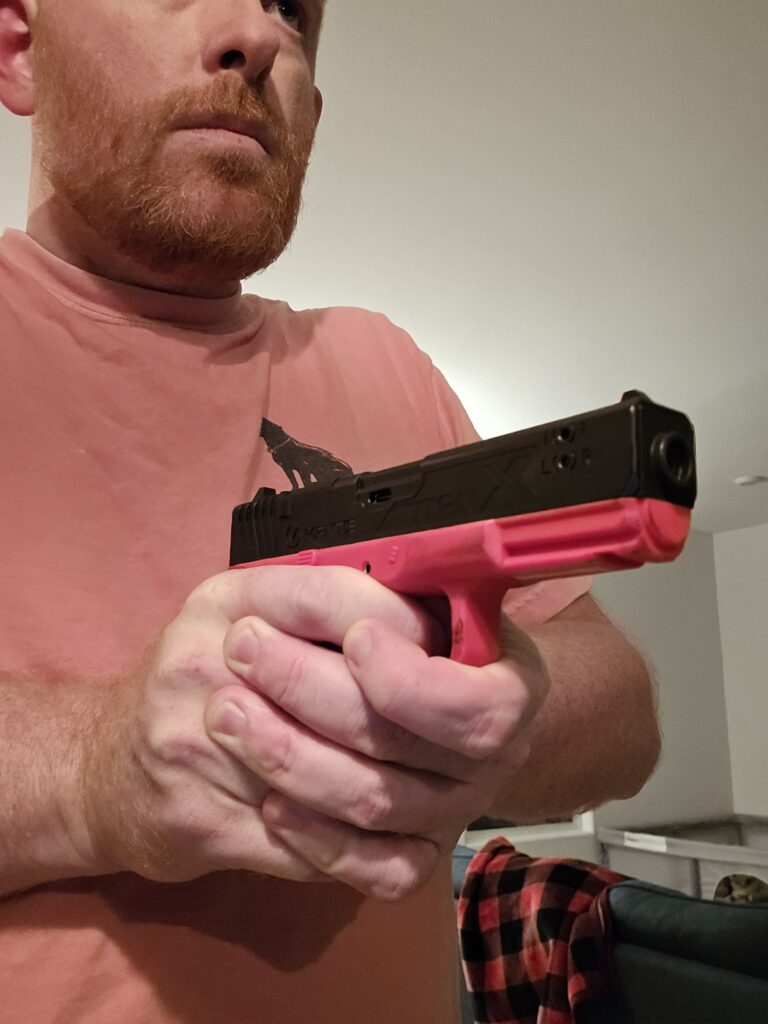
However, these other options often cost a comparable amount to the TitanX, and lack the Mantis system present here. It’s not necessarily a breakdown of what’s overall better, but what suits your needs best. The TitanX may be your best bet, or it may not be. For my purposes, this is a solid option with a few bonuses inside the Mantis system, such as the aforementioned decision making drills.
Closing Thoughts on the Mantis TitanX
There are a handful of comparable dry practice tools out there. Overall, I think the Mantis TitanX compares favorably to the competition. It’s not the cheapest, nor the most expensive options. The Mantis system is a unique feature set not offered by other tools. Consider this part of your dry practice toolkit rather than a single piece solution or 1:1 for a real gun.
This has allowed, or motivated, me to practice with more regularity than standard dry practice. The ability to safely keep the TitanX out in the open at most times removes a large barrier to practice, especially as a parent of young children. My training sessions are short, just over 50 rounds typically, and sometimes fewer. The TitanX is an easy way to quickly get a few trigger presses or drawstrokes in. The TitanX, paired with other dry practice tools, along with traditional dry (and live) practice have made for an excellent system to maintain and grow my skills. I’m glad to have this in my home, and I see it sticking around for a long time.
MSRP on the Mantis TitanX sits at $199.00 as of this writing. You can get yours >>HERE<<
Support My Work
If you made it this far, thanks for reading! Writing isn’t my full-time profession, and nearly everything I do comes out of my own pocket. Between ammunition, tuition, range fees and more, expenses add up fast. If you like what I have to offer, consider making a donation to my Patreon.
Every bit helps bring more work like this to you, and contributes to shortened timelines or more in-depth work on my part. You’ll also have more direct access to me, offering suggestions for future projects, looking behind the scenes, and getting early access to some content. You can find my Patreon >>HERE<<



Be the first to comment