
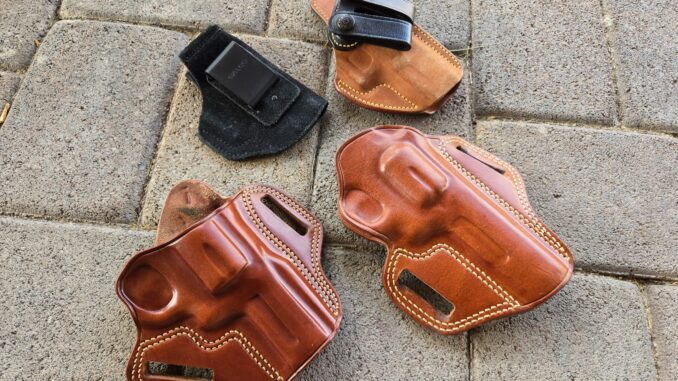
While leather holsters ruled the roost for duty and concealed carry for decades, the last several years have seen the rise of kydex holsters. Much like the Glock, these mass produced, relatively simply products have taken the market by storm, with high quality leather moving into more of a boutique or semi-custom market share. One of the shortcomings of this transition is a loss of knowledge on the part of the end user when it comes to leather goods. It’s not uncommon to see poorly made cowhide holsters on the shelf at your big box store, which put a sour taste in the shooter’s mouth. Over the past few years I’ve been experimenting with a variety of leather concealment holsters, and have found myself pleasantly surprised. I hadn’t given them nearly as much credit as they deserve, but I knew I still had more to learn.
Leather Holster Q&A with Galco Gunleather
To help fill gaps in my knowledge I sought out older texts from when leather holsters were standard. From Gaylord to Bianchi and more, I’ve read more on the subject than most shooters can fathom. But there’s more than just decades-old books to rely on. To see how things have continued to change I reached out to a handful of high-quality leather makers to answer some questions I still had. Today, we’re chatting with Mike Barham, the Media and PR Manager for Galco Holsters to answer these questions. Let’s take a look at what he has to say, busting myths and learning best practices.
Q: To start things out, can you tell us why someone would, or should, choose a leather holster over something like kydex or similar “hard shell” materials?
There are several reasons to prefer leather to plastics. Comfort is probably at the top of that list. A leather holster will gently mold and form itself to your individual body shape over time, making it almost a part of you. This can greatly increase wearer comfort. A hard plastic holster is what it is, and will never form itself to accommodate your body.
More subjectively, leather has a friendly warmth, feel and smell that can’t be replicated by plastic. Mankind has worked with and used leather for millennia, and when something works, it works. We’re actually seeing a growing modern movement away from plastics and toward natural materials in everything from clothing to pillows to holsters these days. Some of this is reflected in the gun world by the trend back to metal guns, too. Look at the “revolver renaissance” of the last few years, or the popularity of the Hi-Power clones on the current market.
Q: In addition to traditional cow leather, we sometimes see holster made of horse hide. For higher end holsters, some people looks for elephant or shark skin trim, and a wide variety of other exotic materials. Are there any benefits to using these extravagant and non-traditional materials over typical cow leather?
I’ll note that Galco works primarily in premium steerhide (male bovine), which is firmer and denser than true cowhide (female).
Horsehide is by far the most practical of the hides you mentioned. The others are largely decorative, and in any case, expensive and difficult to obtain (at least in quality hides). Horsehide is amazingly non-porous, however, and that’s both an advantage and a disadvantage. It resists sweat and other moisture extremely well, but the downside is that it’s hard to work with and harder to get. These factors increase the price of horsehide.
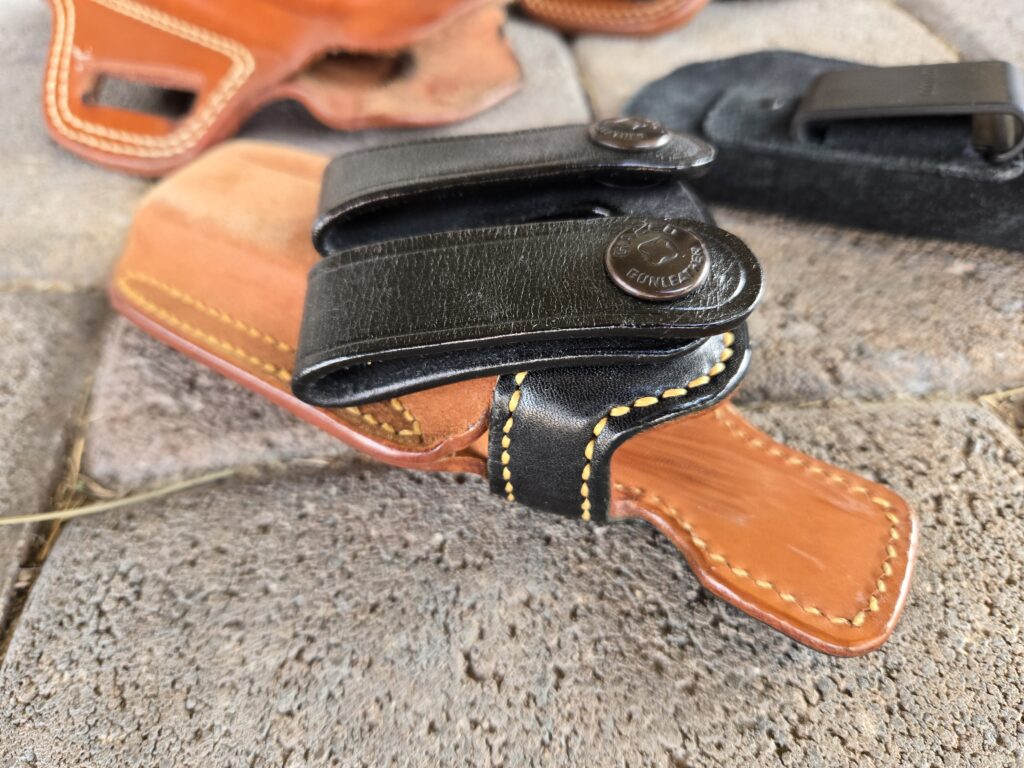
Exotics are very cool and fun. They’re largely decorative, though. Our are made with a layer of the exotic hide over a horsehide substrate. They’re highly functional, of course, but no more so than a standard holster.
Galco has found premium steerhide to be the best combination of several competing factors for holsters and shooting accessories. We compete for the top 2% of available domestic steerhide production from the two remaining vegetable tanning facilities left in the US.
Q: While not always advised, it’s not uncommon for people to mix and match guns with their holsters. This can be as simple as using a shorter barreled gun than what the holster was designed for, such as a Glock 19 in a Glock 34 length holster, or a taper barrel S&W Model 10 in a holster designed for a bull barrel. In somewhat more extreme situations, some people may use a Colt D-Frame revolver in a holster designed for a S&W K-Frame, with the gun being slightly undersized. Are there any concerns with this practice that people should be aware of when it comes to leather holsters?
Barrel shape or barrel/slide length seldom makes much difference here, unless were talking extremes. A Glock 19 will work fine in a holster for a 34, you’ll just have “bonus” material at the muzzle end. (But hey, no extra change for the bonus leather!)
There’s a major caveat when sizing down in frame size, though, and that’s retention. A handgun that’s not fully secured in the holster may be jarred loose during the course of daily carry. This is a problem for very obvious reasons.
The other side is that an undersized handgun can slip too far down into the holster and precluding a firing grip. If you can’t get a firing grip on the handgun in the holster, you’ll need to adjust your grip as you draw. This is clumsy and slow, in a moment when you need to be neither of those things.
Q: I don’t often see leather holster manufacturers using some of the modern hardware used for mounting holsters to the belt, or to improve concealment at the appendix position, such as a Modwing, concealment wedge, or metal belt clips from Discreet Carry Concepts. Are there downsides to using these with a leather holster, and if so, what alternatives do you suggest?
The stabilizing claws/wings are helpful in the AIWB context. We’ve experimented with them on leather holsters. However, given leather’s flexibility and eventual comfortable conformance to the user’s body, we haven’t really seen a need to pursue it. That said, AIWB carriers remain in a minority among our customers. Those shooters tend to gravitate heavily to hard-bodied kydex designs, which we don’t offer.
Q: When it comes to kydex holsters, there are some shooters who take it upon themselves to make modifications. This can be opening up a closed muzzle, making cuts to accommodate optics, and more. What advice would you give to someone looking to make adjustments such as those to their leather holster?
I wouldn’t.
We don’t recommend modifying your Galco holster in any way, aside from using items we offer (like replacement belt loops, for example).
Q: In my experience, some leather holsters do an excellent job resisting moisture absorption, rivaling that of “hard shell” holsters across extended and repeated exposure. Some leather holsters act like a sponge, quickly soaking up any sweat, rain, or other wetness they come across. What causes this difference in moisture resistance?
Porosity, primarily. Horsehide in particular is less porous than cheaper leathers. Premium steerhide also survives moisture much better than cheaper leathers like cowhide.
Q: It seems that most manufacturers do not offer holsters set up for weapon-mounted lights (WMLs), or optics. What do you think the reason for this is, and are there concerns behind those accommodations when it comes to leather holsters?
WMLs and carry optics are really separate issues, so let me break it down a little.
With WMLs, there are two challenges for holsters makers. The first is simply the huge number of available gun/light combinations. Think about guns first: Glock, SIG, S&W, Springfield, Walther, etc., each with many variations in model, frame and barrel length. Then stack on that all the lights in various sizes and shapes from Streamlight, Surefire, Olight, etc. The possible combinations are in the hundreds or thousands. Designing, making and inventorying holsters for all these combos just isn’t economically feasible – and it becomes even more challenging when new WMLs are introduced every six months or year.
The second WML challenge is trigger protection. The width of some popular WMLs (Surefire X300, Streamlight TLR-1, as examples) requires a holster wide enough that fully protecting the trigger becomes a major challenge. You often see holster gaps around the trigger guard where a small finger or other object could physically come in contact with the trigger, which is obviously “suboptimal,” and something Galco strives to avoid. Holstermakers have to tread very carefully here.
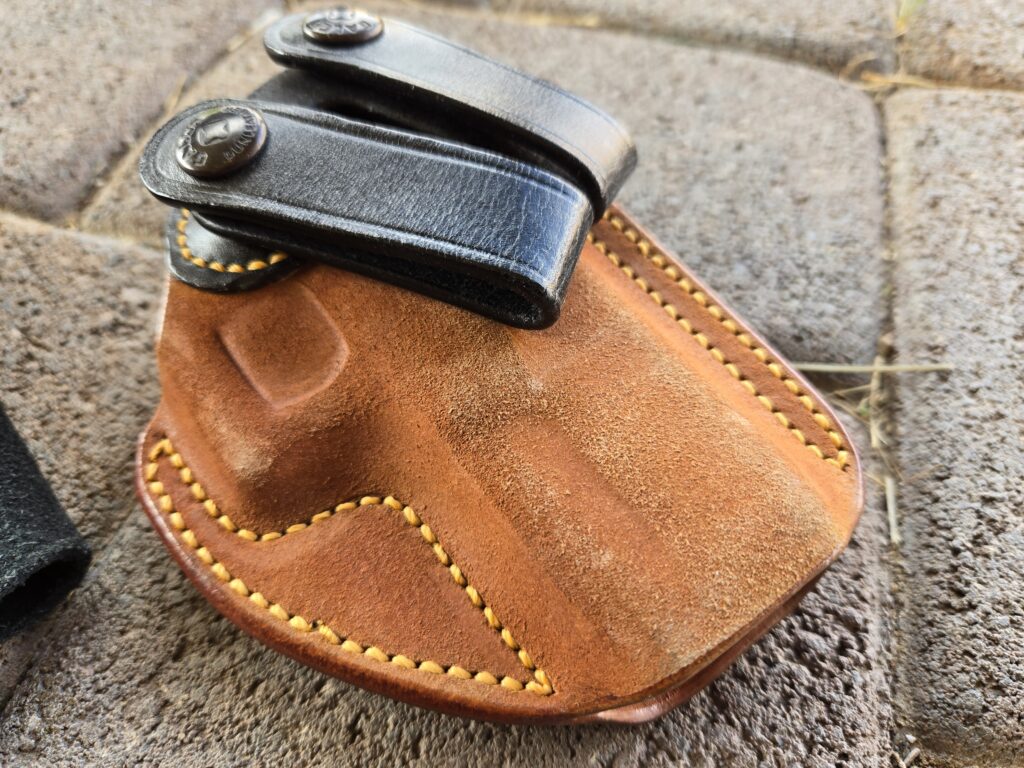
With carry optics, it’s often just a matter of older holster designs being incompatible with optic positioning. This is most prominent in the popular pancake-style design, where the stitching comes all the way up the front, along the top of the slide. You can’t just cut a hole here because of the way the holster is designed. Thus, some legacy designs can’t be retrofitted to work with optics. That said, pretty much everything we’re designing going forward (with one exception) will be designed to accommodate carry optics.
Q: As a manufacturer of leather goods in the age of kydex, I imagine you get more than your fair share of customers who don’t fully understand what they’re looking for when they place an order. What are some common mistakes or misconceptions on their part that lead to complaints or other misunderstandings?
By far the biggest thing we see from folks unfamiliar with leather holsters is the necessity for a break-in. Premium leather holsters are wet molded, and when leather gets wet, it tends to shrink a little as it dries. Leather being a natural material, some holsters shrink a little, some shrink a lot. A quick break-in often needed to “remind” the leather fibers of where they need to be.
Nearly every premium leather holster (except our Masterbilt series) will need at least a little break-in to perform perfectly, just like a new pair of leather boots or a baseball glove. This is a very easy process, but lots of newer/younger folks aren’t familiar with the necessity or the procedure.
Q: Is there anything that users should look out for, or that they should know, when shopping for a leather holster that has not been covered here?
I think a lot of people simply don’t know what to look for when spending substantial money on a quality leather holster. Top-quality holsters show it in their construction. The first tell of a quality craft product or factory-made item is “fit and finish.” The fit refers to the precision by which different (in this case) holster parts fit together, which gives an impression of a holster’s overall quality.
Finish is often the litmus test for quality issues that are more technical in nature: Do the edges of the leather line up? Are the edges sanded, polished and painted? Is the stitching straight? Often, a budget or medium-quality holster will have very minimal time spent on fit and finish. At Galco, we take the opposite approach with our premium-grade holsters and accessories.
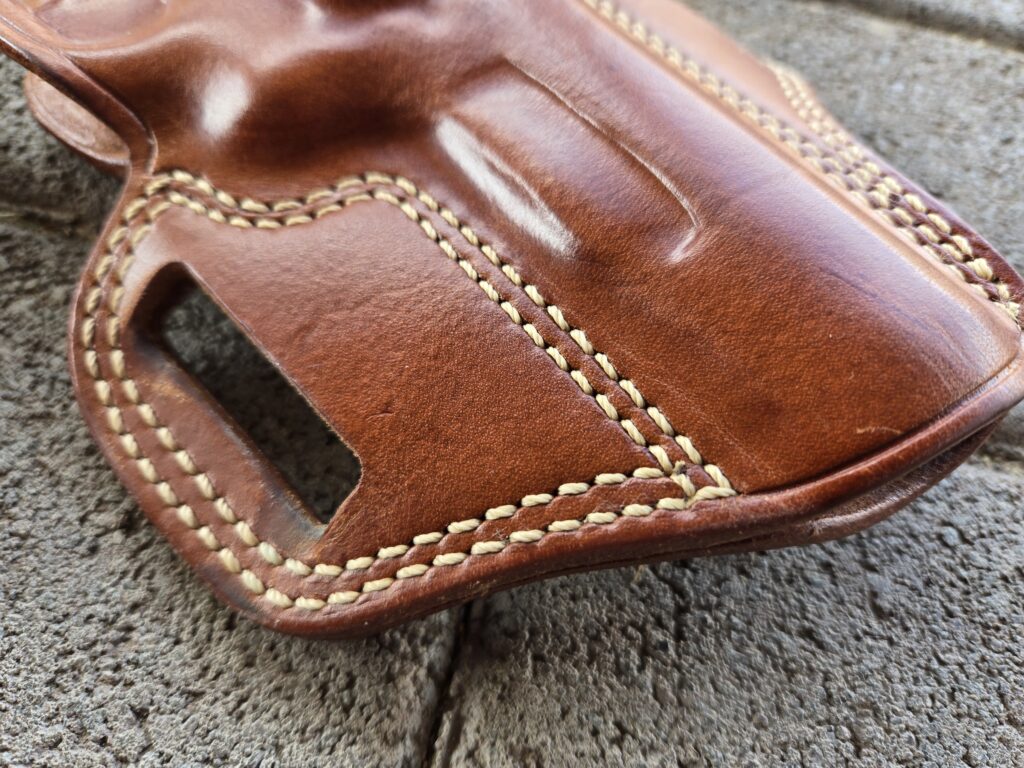
Galco’s premium steerhide holsters are all molded by hand, as they been since the 1970s. The back and forth burnishing with our custom-made hand boning tools allows the cased leather to mold to the gun, without separating the grain from the flesh. This imparts a burnished look, most noticeable in our hand-rubbed oil tan color.
Ultimately, though, the quality of a leather holster comes down to the quality of the leather itself. Galco purchases the top 2% of available domestically-produced, vegetable-tanned steerhide. We compete with leather purchasers in many other industries, but we secure this premium leather so that we can produce the very best American-made holsters available.
Closing Thoughts on Leather Holster Q&A with Galco Gunleather [2026]
Thank you to Mike for taking the time to answer my questions! I’ve relied on Galco holsters for several years, and still regularly find one on my hip today. Hopefully this piece has answered some questions or busted a few myths for you.
Support My Work
If you made it this far, thanks for reading! Writing isn’t my full-time profession, and nearly everything I do comes out of my own pocket. Between ammunition, tuition, range fees and more, expenses add up fast. If you like what I have to offer, consider making a donation to my Patreon.
Every bit helps bring more work like this to you, and contributes to shortened timelines or more in-depth work on my part. You’ll also have more direct access to me, offering suggestions for future projects, looking behind the scenes, and getting early access to some content. You can find my Patreon >>HERE<<



3 Trackbacks / Pingbacks