
I’ve been using Trijicon optics for over seven years as of this writing, with my original RMR still going strong. When Adam from Aridus Industries sent me a CROM, I needed a new RMR-footprint optic to pair with it. This was a great opportunity to try out some of the new optics Trijicon brought out a few years ago. Knowing it’d go on my Beretta A300UP, I wanted to have an enclosed emitter optic, which gave me a single choice, the Trijicon RCR. After several months with it mounted to a shotgun, it’s time to review the Trijicon RCR.
Construction of the Trijicon RCR
In very simple terms, the Trijicon RCR is an enclosed reticle version of the RMR. It features the same footprint as the RMR, along with the same deck height. This means that shooters won’t need a new plate or optic cut to accommodate the RCR, and their old iron sights will work fine as well. Size wise, it sits in a somewhat unique position, being slightly taller, while also slightly shorter (front to back) than some of its competitors such as the Aimpoint ACRO or Steiner MPS. Coming in at 1.95oz, it is slightly lighter than some enclosed optics as well.
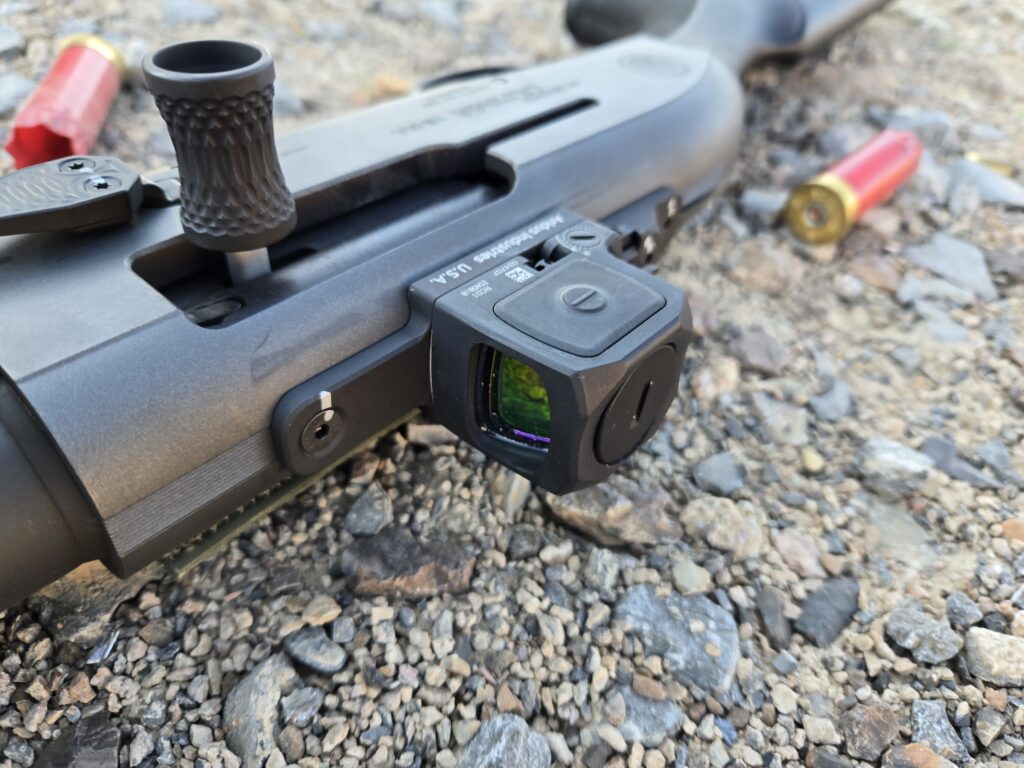
What stands out on the RCR is its mounting method. You may have wondered how Trijicon managed to use the RMR footprint for an enclosed optic, and their solution is both unique and effective. The RCR uses capstan screws, which are tightened through the side using a small tool, rather than a traditional screw driver. This keeps the housing fully enclosed while taking advantage of the wide variety of RMR pattern mounts on the market. I was a little intimated by this unusual mounting method when I received my RCR, but it turned out to be incredibly intuitive. While Trijicon includes a neat reference chart for tightening your capstan screws, I effectively did what I usually do, and tightened until it wouldn’t tighten anymore, and then gave it another push.
I’d go into more detail here, but Trijicon’s documentation for mounting the optic is far more robust than I could hope to replicate here.
Battery and Function
The Trijicon RCR is powered by a CR2032 battery which provides a quoted six-years of continuous use of setting 5 of 10. Batteries are inserted into the top of the optic, held in place by a screw-in cap, which can be removed using a flathead screwdriver or similar object. This allows the RCR to stay mounted to your gun when swapping batteries, maintaining your zero. Much like the RM06, there is no shake-awake or auto brightness adjust here. While some may complain about this perceived lack of features, this is my preference. The RCR is a simple optic, which means there isn’t much to go wrong.
Controls and Adjustments on the Trijicon RCR
Controls are simple and familiar for those who have used Trijicon optics in the past. There are two buttons two adjust brightness, one on either side of the RCR. The “-” dims the optic, and the “+” brightens the reticle. Hold both buttons for six seconds to turn off the RCR, and simply press one of the two to turn the optic on. Brightness can be locked-in by holding either adjustment for three seconds. There are ten brightness settings here, three of which are dedicated night vision settings.
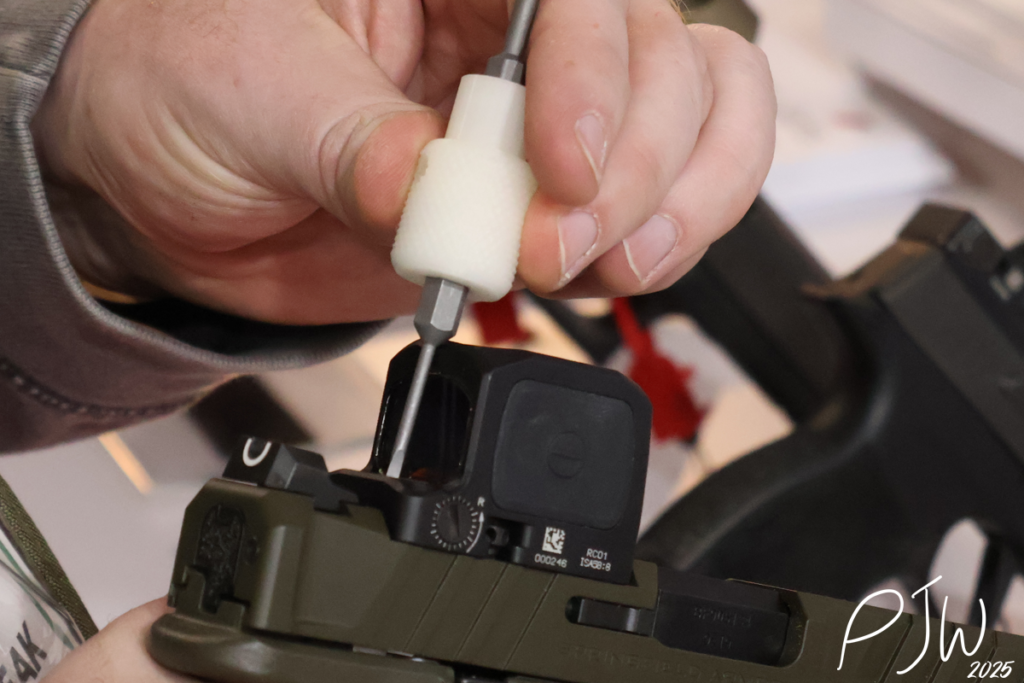
Windage and elevation adjustments are just like the RMR. Each is click-adjustable, providing a slight audible and tactile indication of adjustment. This can be done with a piece of brass, screwdriver, or other tools. Overall the RCR features 150MOA of adjustment, with each click equaling 1-inch at 100 yards.
Reticle and Glass Quality
If you’ve seen an RMR, then you’re familiar with the RCR. We have a 3.25MOA reticle, with red currently being the only color available. Glass quality is solid, with a fair bit of tint to the window, along with slight distortion. The glass is definitely better than many cheaper optics, but isn’t quite best in class either. Overall I’m not upset with the glass or reticle, and I’m glad to see consistency across my three Trijicon optics.
Range Time with the Trijicon RCR
I mounted my Trijicon RCR onto my Beretta A300UP using an Aridus Industries CROM in late 2025. It has lived atop this shotgun for the entirety of the review process, seeing time in regular range sessions and as part of the T&E process for other components on my Beretta. As of this writing, the RCR has seen approximately 1,322 rounds fired through it. Below is a breakdown of rounds fired during this review.
- 80x Winchester AA Xtra Light #7.5, 2-3/4″
- 13x Remington Gun Club #7.5, 2-3/4″
- 16x Federal Top Gun 7.5 shot
- 50x Fiocchi Shooting Dynamics Target 7.5, 2-3/4″
- 25x Bioammo Rex #8, 2-3/4″
- 83x Winchester Super X #8, 2-3/4″
- 425x Federal Top Flight #8, 2-3/4″
- 5x Remington Peters #8, 2-3/4″
- 50x Remington Gun Club #8, 2-3/4″
- 25x Federal Field and Target #8, 2-3/4″
-
50x Federal Game Load Heavy Field #5, 2-3/4″
-
25x Federal Game Load Heavy Field #7.5, 2-3/4″
- 20x Winchester Pheasant #6, 2-3/4″
- 50x Winchester AA Lite #8, 2-3/4″
- 40x Federal Flite Control 9 pellet, 2-3/4″
- 5x Remington Slugger 1oz slug low recoil, 2-3/4″
- 9x Winchester Super X slug, 2-3/4″
- 35x Federal Power Shok 1oz slug, 2-3/4″
- 6x Estate 00 9 pellet, 2-3/4″
- 10x Winchester Defender 00, 2-3/4″
- 160x NSI 00, 2-3/4″
- 15x Federal Power Shok #1 buck, 2-3/4″
- 10x Federal Tru Ball slug, 2-3/4″
- 25x Federal Speed Shok Steel #3, 2-3/4″
- 25x NSI Waterfowl #2, 2-3/4″
- 25x Winchester AA Xtra Light #7.5, 2-3/4″
- 15x Winchester Super X low recoil slug, 2-3/4″
- 15x Remington Slugger 1oz slug, 2-3/4″
- 10x Brenneke bear protection 1-1/4oz slug, 2-3/4″
Throughout the review process the Trijicon RCR has stayed solidly mounted to the A300. Brightness has been solid in the desert sun, and in general, I have no complaints about the RCR in this configuration. Of note, the window of the RCR makes for a stellar ghost ring with the front post of the A300, which is an excellent option if your reticle were to ever fail you.
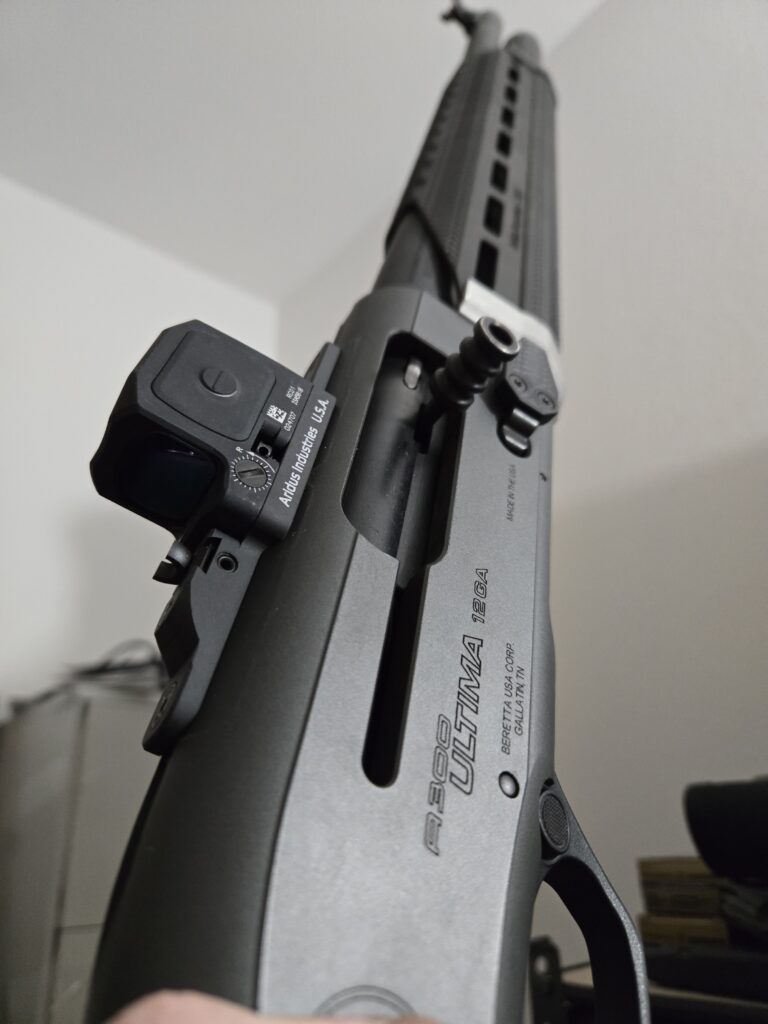
In addition to traditional drills, I also shot hundreds of clay pigeons during my review. I had zero issues hitting midi 90mm clays out to 40 yards with this setup if I did my part. While I’m no expert, I made several doubles, including a handful where both targets went down to a single shell. While I’d look out of place, I wouldn’t feel bad showing up to the trap and skeet fields with this setup.
Final Thoughts on the Trijicon RCR
Overall I’m very pleased with the Trijicon RCR. It’s proven to be a reliable optic that comes with solid features for a reasonable price. Had Trijicon released this a few years earlier, I think it’d be a bigger contender in the enclosed optic market. At some point I may pick up a second RCR to see what I think of it on a pistol, as that is a totally different world. At this point, I have no plans to pull this optic off of my shotgun. If you’re thinking about picking up a new red dot, consider the Trijicon RCR.
MSRP on the Trijicon RCR sits at $1,019, though street prices seem to hover closer to $700.
Support My Work
If you made it this far, thanks for reading! Writing isn’t my full-time profession, and nearly everything I do comes out of my own pocket. Between ammunition, tuition, range fees and more, expenses add up fast. If you like what I have to offer, consider making a donation to my Patreon.
Every bit helps bring more work like this to you, and contributes to shortened timelines or more in-depth work on my part. You’ll also have more direct access to me, offering suggestions for future projects, looking behind the scenes, and getting early access to some content. You can find my Patreon >>HERE<<



Be the first to comment