

If you’ve been reading Primer Peak for the past few years, you’ve probably seen me talking about 30 Super Carry. At this point, I believe I may be one of the most experienced people on the planet who isn’t sponsored by an ammunition or firearms manufacturer. For those unfamiliar with the cartridge, check out my Primer on 30SC to get an idea of what we’re talking about. While I still advocate for the round, and carry it daily, it’s certainly not a success story. In fact, it may be fair to say that 30 Super Carry has failed. With this in mind, let’s look at some of the reasons why we’ve reached this point.
Why 30 Super Carry Failed
In short, I think marketing was the big failing with 30SC. Nobody knew what it was or how to sell it, and frequently the marketing misrepresented the round. We can’t blame the general public, or even the influencers for this failing. It’s up to Federal, Remington, CCI, and Hornady to explain the benefits of this new cartridge. Smith & Wesson, and Nighthawk Custom are also at fault for failing to properly educate folks on the benefits of the guns they created in 30 Super Carry. Hi Point, and Avidity Arms are also responsible, to a lesser degree, as later-comers to the market.
I’m not sure how this gap in information came to be. Clearly someone had an idea which made it to market, yet 30SC lacked a cohesive identity from the start, and never found one in the following years. In short, I describe 30 Super Carry as “9mm plus capacity”. We’re trying to closely replicate 9×19’s performance and shooting characteristics, while increasing capacity in standard firearms. That’s it. It’s not a magic bullet, it’s not a pocket gun, and it’s not a Magnum load. We get duty performance with more bullets in the magazine.
This is an over-simplication of course, so let’s dive into the details.
Firearm Selection
From the outset, firearm selection in 30 Super Carry was abysmal. Smith & Wesson, and Nighthawk Custom offered two pistols each in the caliber. Nighthawk offered a pair of semi-custom 1911 pistols, both of which ran well over $3,000 a piece. To date, the only person I know who owns one of these is Tim Herron, who is sponsored by Nighthawk. From S&W, we have the Shield EZ, and the Shield Plus. Later, Hi Point released one of their carbines in the caliber, followed by Avidity Arms with the single-stack PD10, which I’ve reviewed here.
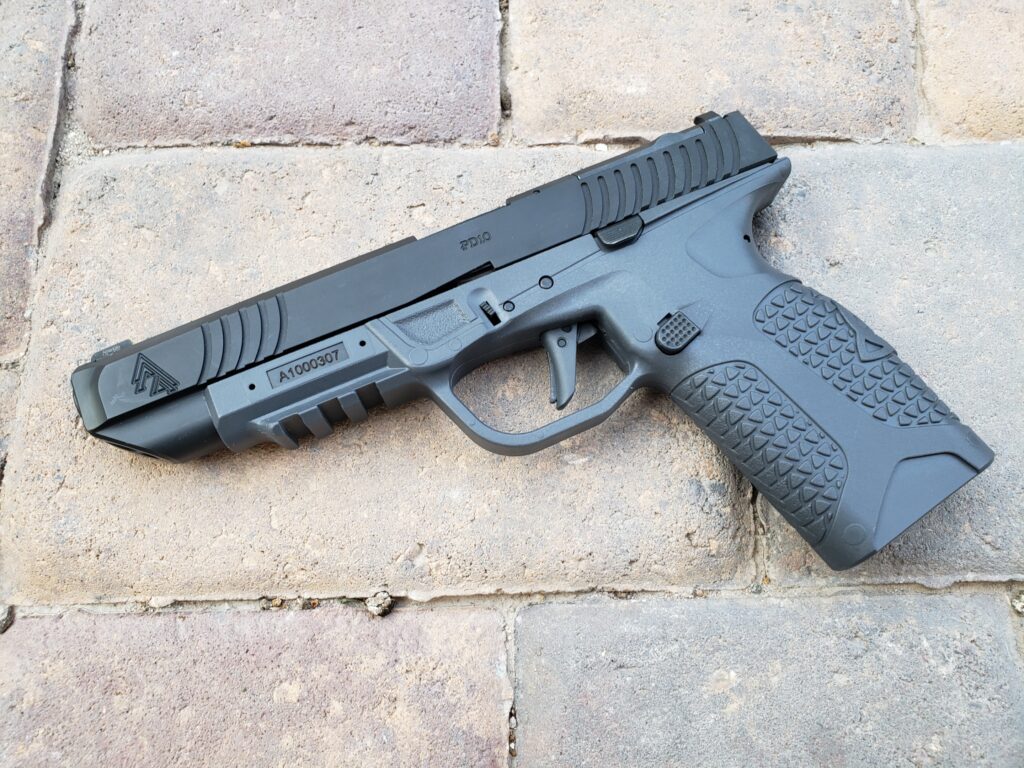
In my experience, the Shield EZ is a horrible gun in all calibers, being unpleasant to shoot and unreliable. The Hi Point Carbine features 10-round magazines, which totally negates any advantage of the new chambering. Nighthawk guns are price prohibitive. The PD10 is a full size pistol with no aftermarket, and middling reliability in my brief experience. This left the Shield Plus as the only viable pistol in the caliber. I’ve owned a 30SC Shield Plus for years, and it’s an excellent gun, but it’s never had impressive sales.
With no duty guns, no competition guns, and one carry option, many shooters sat on their hands waiting for something to hit the market in their preferred make or model. Poor sales makes manufacturers hesitant to support 30SC. A self-fulfilling prophecy if I’ve ever seen one.
Ammunition Selection, Price, Performance, and Availability
One of the most common comparisons I see with 30 Super Carry is it versus 380ACP. Even marketing from Federal put 30SC between 380ACP and 9mm, as if it occupied a middle ground or “sweet spot” between the two for carry guns. That simply isn’t the case. Between case length (21mm) and pressure, 30SC would never work in a typical 380ACP pistol, and would be a seriously unpleasant experience if you tried. This led people to be confused about the available guns, thinking that a 380-equivalent in a Shield Plus or larger was too much gun for the caliber. Those thinking it was more akin to 9mm or hotter wanted a larger pistol to support it, such as a G19 equivalent. Without knowledge of what kind of firepower 30 Super Carry offers, nobody knew what to think.

Ammunition options were solid in terms of supply. There were four defensive loads, and three options for practice ammunition at its peak. For practice ammo we had Federal American Eagle, Remington UMC, and CCI’s Blazer Brass. Defensive options included Federal HST and Punch, Remington HTP, and Hornady Critical Defense. All of these were reliable, and widely available in-person and online, with 1,000 round cases easy to find. One shortcoming, which isn’t unique to 30SC, is that the ammunition was designed around duty sized 4-inch barrels. You may notice that there are ZERO duty guns available in 30 Super Carry. This can lead to reduced performance in the shorter barrels found in the Shield Plus, but as far as I know, I’m the only one who ever covered this!

Another major complaint was the price of 30 Super Carry ammunition. As a competitor to standard 9mm, everyone compared the price per round to that of 9×19. This is bad argument in my mind, as nothing aside from 22LR can compete with 9mm in terms of cost. There simply isn’t the volume to drive down prices. 30SC is more readily comparable to rounds like 45ACP, 10mm, and 38 Special. They’re absolutely more expensive than “nine”, but still enjoy good sales and followings. This failure of mindset is more on the customer, but it’s still a major contributing factor to Super Carry’s downfall.
Capacity Misunderstandings
Firearms and ammunition manufacturers under-sold the potential capacity advantage of 30 Super Carry. This is especially egregious, as improved capacity is essentially the only benefit of 30SC. In a world where we’re constantly trying to shove more rounds into our pistols, you’d think this would be a great marketing tool. While the Shield Plus is a better gun (in my opinion), shoving 30SC into a SIG P365 would’ve been marketing genius.
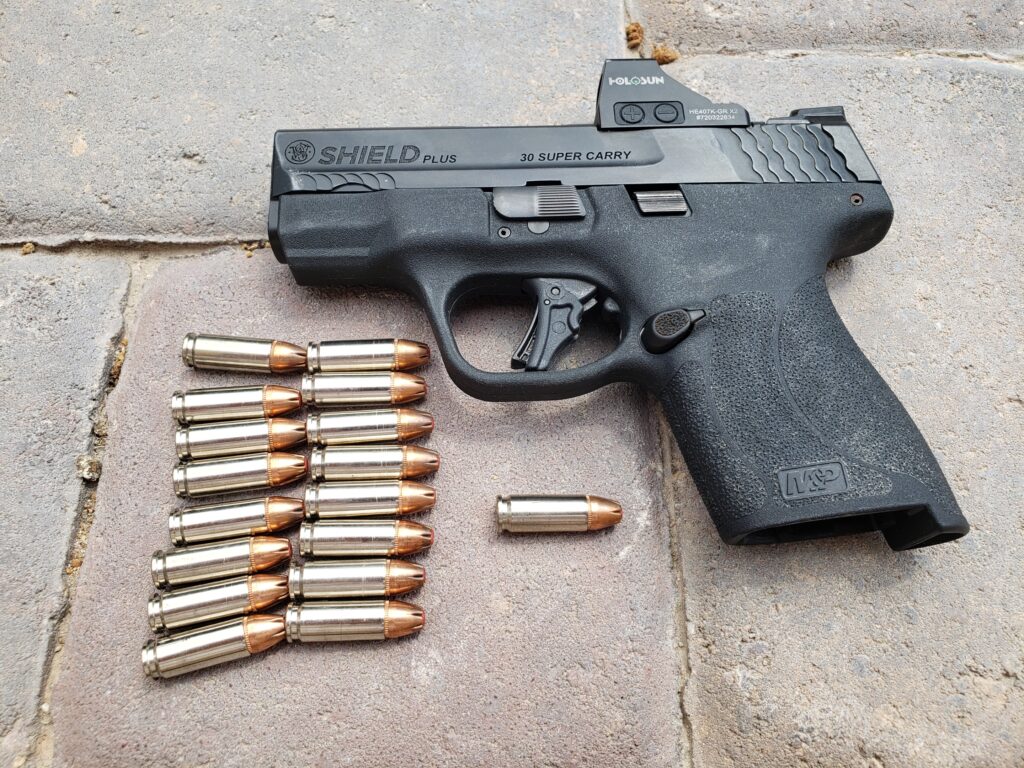
Virtually all marketing claimed that 30 Super Carry provides you +2 to your capacity, but that isn’t necessarily correct. The increased capacity is not a fixed number, it grows along with the magazine. For a single stack gun such as the Shield EZ, 1911, or PD10, you will only add an extra two rounds to your magazine. However, moving up to the P365 equivalent Shield Plus already gives us +3 in our magazine, bringing that gun to 13 and 16 round magazines respectively. That’s more than a Glock 19 in a much smaller package.
To continue down this rabbit hole, I loaded a Glock 17 magazine with 30SC rounds for an estimate of what a full size pistol in the caliber could hold. I was easily able to fit 21 rounds of 30SC into my OEM G17 magazine. That’s an additional 5 rounds, which could make a major difference in a match or defensive encounter. After this, I repeated this process using a G17 magazine equipped with a Taran Tactical +5 extension. This configuration allowed for 27 rounds of 30SC to be loaded into what would normally be a 22-round magazine in 9×19.
Competition Prohibition
Of lesser importance, but still a factor, is the inability to use 30 Super Carry in virtually any sanctioned competition event. IDPA, USPSA, USSCA, and PCSL all require a minimum bullet diameter of .35″ or 9×19 for their caliber restrictions. This means you can’t show up to a match with your carry gun, and nobody is winning Regionals or Nationals with your new caliber. It’s my belief that Federal should have pumped money into the brand-new (at the time) PCSL to get their caliber approved, even just for one or two seasons. While you likely would have had no luck convincing the more established organizations to make such a change, a newcomer may be more open to such a proposal, especially if you help them get off the ground.
Closing Thoughts on Why 30 Super Carry Failed
In summary, a lack of cohesive identity for 30 Super Carry led to a lack of support from firearms manufacturers, which in turn created a lack of confidence and interest in this new round from the buying public. It was nearly dead on arrival, despite offering some serious benefits with a lot of unfulfilled potential. I hope that things can turn around and start to improve for 30SC, as I’m still a huge supporter. If you’re curious, pick up a Shield Plus, grab some ammo, and make your voice heard by the manufacturers.
Until then, let it be known that these reasons are why 30 Super Carry failed.
Support My Work
If you made it this far, thanks for reading! Writing isn’t my full-time profession, and nearly everything I do comes out of my own pocket. Between ammunition, tuition, range fees and more, expenses add up fast. If you like what I have to offer, consider making a donation to my Patreon.
Every bit helps bring more work like this to you, and contributes to shortened timelines or more in-depth work on my part. You’ll also have more direct access to me, offering suggestions for future projects, looking behind the scenes, and getting early access to some content. You can find my Patreon >>HERE<<



3 Trackbacks / Pingbacks